 Slaughter of the Suitors, Gustav Schwab[/caption]
It is with reverence and trepidation that I stepped into the land of these old gods. The Greeks made their gods as petty as they are powerful. Voltaire (or Uncle Ben) had not come along yet to tell them that with great power comes great responsibility, so they used their power selfishly. Thousands of years later the people who gave them power no longer believe in them. They have been replaced by more benevolent, more omnipotent, and more sensible gods. We read their lives only as folklore, laugh at their vanity, and teach lessons to our children.
Slaughter of the Suitors, Gustav Schwab[/caption]
It is with reverence and trepidation that I stepped into the land of these old gods. The Greeks made their gods as petty as they are powerful. Voltaire (or Uncle Ben) had not come along yet to tell them that with great power comes great responsibility, so they used their power selfishly. Thousands of years later the people who gave them power no longer believe in them. They have been replaced by more benevolent, more omnipotent, and more sensible gods. We read their lives only as folklore, laugh at their vanity, and teach lessons to our children.

Athens is the heart of Greece. Before it even had a name, Athena and Poseidon fought to be the god of this city. Even in those days, gods had to win the heart of men. Poseidon brought them a gift of naval power, war horses created out of sea foam. Athena gave them the olive tree, a symbol of peace and prosperity. The people accepted the olive tree, and Athena became their patron god. As promised, the city prospered, becoming the foundation of Western civilization during the 5th century BC. They built this temple for her, the first of many atop the Acropolis, over 400 years before the birth of Christ. They called it the Parthenon, the home for the unmarried maiden, for their goddess never had a lover. The temple was lined with columns and lavishly decorated with sculptures, and within the temple laid the treasury of the Athenian Empire.

Then the people of Athens went to war, the strongest city-state of its time versus the Peloponnesian League led by Sparta. so the goddess of philosophy used her wisdom for military intelligence and strategy, and become the goddess of the heroes. Her people built her another Temple, a smaller one, for Athena Nike, or winged victory. The people took away her wings when they put her statue in the cella. It was said that they did so to make sure victory does not leave the city.
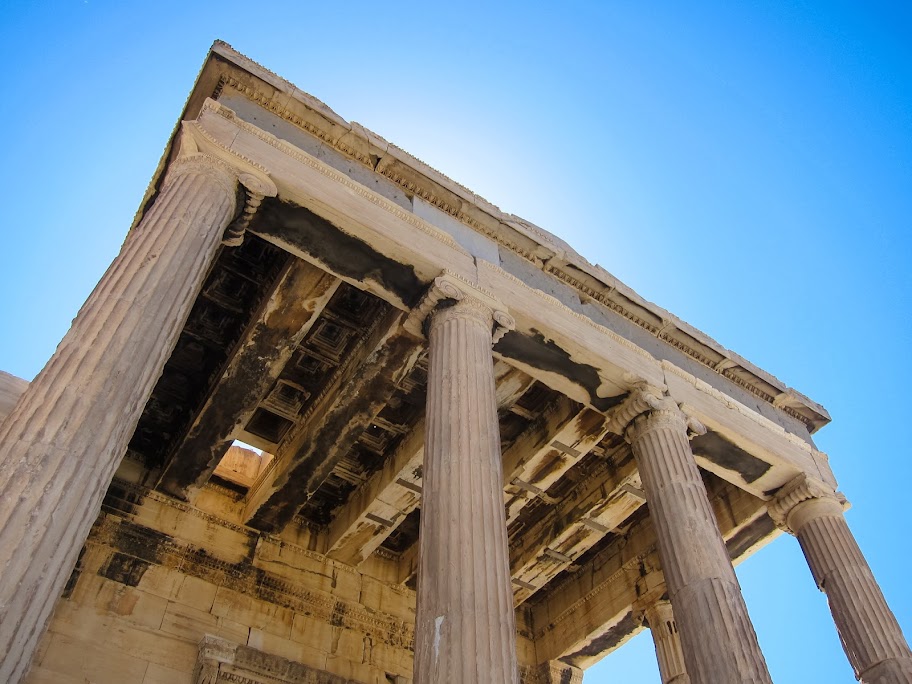 The Athenians lost the war. Perhaps their goddess did not appreciate getting her wings clipped, or the people just became too greedy. The temple deteriorated with the city itself, until a fire in 3rd century AD destroyed much of its roof and interior. Another 200 years later, the Byzantine emperor Theodosius declared all pagan temples in his domain be closed. Hundreds of years followed where Athena allowed her temple to be looted, converted for the use of worshipping one god then another, until finally it was destroyed in 1687 in a war between the Ottoman Turks and the Venetians. The Turks used the sanctuary to hold gunpowder, the Venetian fired a mortar round, and the goddess of Athens lost her home.
 Greece won its independence in 1832, after the Acropolis has been looted for 150 years since the Parthenon's destruction. It took another 150 years before the Greek government began a concerted effort to restore the Acropolis in 1975. The project had a budget of $23million and was expected to take less than 10 years. This is what it looks like today, almost 40 years later.

The magnificent sculptures that once told the glories tales of Athena now resides in the museums of London and France, as well as the Acropolis Museum. The gods are missing their limbs and heads, some have been found and reattached, others filled in with imagination. They still tell a story, but a much more painful one.

The people still come. Even if they worship a different god, or none at all. As for the gods? Perhaps they are still there too.

Athens is much more than its old gods. We wandered through the Agora Central Market with its display of meat and spices.

Where we met dogs who are too lazy to eat sausages.

I hung out with men with big shoes.

And found a familiar face.

I enjoyed the food.

And the graffiti even more.


We spent a most wonderful afternoon on top of Philopapou Hill looking over the city.

But I do miss the gods. As petty, vain, selfish, and human as they are.
